
The Real Reasons Why Customers Churn (And What Actually Works)
Learn why customers churn, the real product and experience issues behind attrition, and practical steps to improve onboarding, retention, pricing, and support.
About half of product initiatives miss their target. That means plenty of smart teams ship features, tweak pricing, and run growth experiments, yet still sit in reviews asking why customers churn and why the numbers refuse to move.
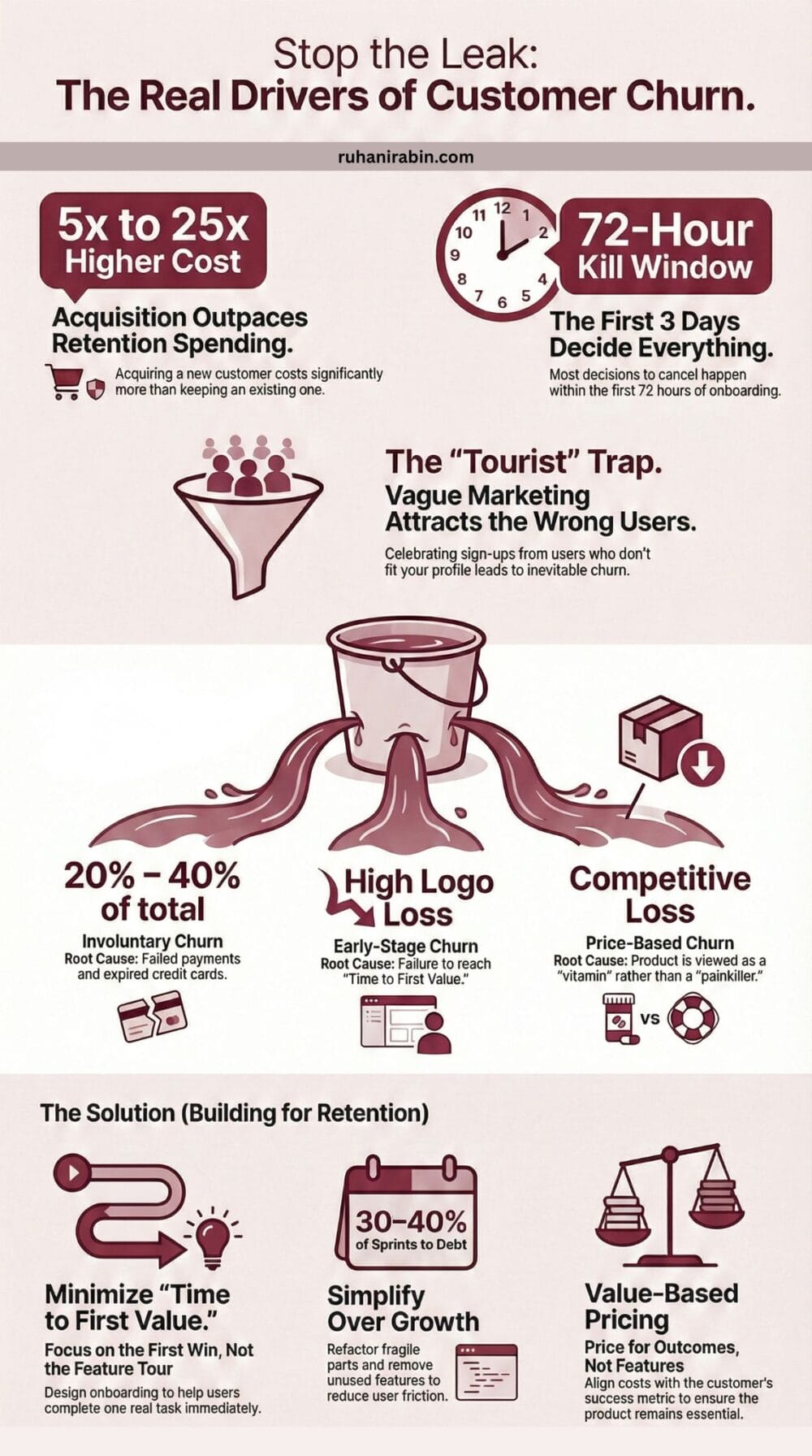
At the same time, acquiring a new customer costs around five to twenty-five times more than keeping an existing one. In my work with SaaS and WordPress product founders, most still spend most of their time on acquisition while treating churn as a side report in a slide deck, despite research on predicting customer churn in subscription-based businesses showing clear patterns that could be addressed proactively. When they ask me why customers churn, they usually start with guesses about pricing, missing features, or a noisy competitor.
Those are symptoms, not causes.
After more than twenty-five years building and fixing products and more than ninety product audits, I see the same pattern over and over. Customer attrition is usually a product clarity and experience problem. Not a sales problem. Not a marketing problem. A product that feels heavy, confusing, or non essential will always push people away, no matter how clever the funnel looks.
In this article I will go past the usual checklist. I will walk through the real systemic reasons why customers churn and what actually works to improve customer retention. The focus is simple and direct. Attract people you can really help, get them to value fast, make the product simpler instead of bigger, and use data that reflects outcomes, not vanity.
Here is what actually drives churn and what to change if you want customers to stay.
“The purpose of a business is to create and keep a customer.”
— Peter Drucker
You Are Solving The Wrong Problem Before They Even Sign Up

Most churn does not start when someone hits cancel. It starts the moment the wrong person lands on your site, reads vague copy, and signs up for a product that was never built for their problem. Then everyone is surprised when that person leaves thirty days later and adds one more tick to the customer churn rate.
Founders love to celebrate signups. I have seen teams cheer when they hit one thousand new accounts while only two hundred of those match the ideal customer profile. The rest are tourists. They bounce around, open support tickets, ask for features that make no sense for the product, and then leave angry reviews when they do not get what they imagined.
This has a real cost:
- Support teams drown in noise from poorly fit accounts.
- Roadmaps get pulled toward edge cases and random requests.
- Churn prevention becomes nearly impossible because no onboarding flow can fix a bad fit.
When you ask why customers churn in this situation, the honest answer is that many of them never should have been customers at all.
A better path starts with sharp positioning and self-selection. Your website should help the wrong people disqualify themselves. Clear, specific copy that says who the product is for and who it is not for feels scary at first, but it filters out users who would collapse your customer retention metrics later. Instead of listing every feature, speak to a narrow, real problem you solve well.
One simple move I often recommend is a thirty-day audit of churned accounts. Look for patterns in:
- Company size and industry
- Primary use case
- Tech stack and integrations
- Expectations they shared with support or sales
Those patterns tell you which leads to stop chasing. When I run product and UX diagnostics for clients, this misalignment between messaging and what the product actually does is one of the first things I look for.
If your customer churn rate is high, start with a blunt question: Are you attracting people you can truly help, or are you pulling in everyone and hoping onboarding will fix the gap?
Your Onboarding Shows Them How To Leave

For most products, the first fourteen days decide retention, and many decisions to cancel happen in the first seventy-two hours. In that window, new users quietly decide whether they believe you can deliver the outcome they signed up for. This early moment explains a huge share of why customers churn.
The problem is that most onboarding flows are not designed to get people to a first win. They are designed to show off features. Long product tours, busy dashboards, and email sequences about company news all miss the point. A walkthrough that points at every button does not help someone finish one real task that matters to their job.
I have a simple line I use with teams: A feature tour is not onboarding. It is a product demo for people who already bought. Onboarding should be about one thing: time to first value. That means how fast a new user can say “this product helped me with a real problem,” not how fast they saw all the menus.
The first value is always outcome-based:
- Sending the first invoice
- Publishing the first article
- Getting the first report that saves a meeting
- Closing the first deal tracked in your system
When I map onboarding in client audits, I look for three to five core actions that lead to long-term retention. Then I strip out every step that does not make those actions more likely.
Effective churn management here means reverse engineering the path from signup to that first success and making it almost impossible to miss:
- Remove optional setup fields that do not block value.
- Defer advanced settings until after the first win.
- Use in-product nudges to guide people through a short, focused checklist.
Most teams still track onboarding completion instead of first success. That hides the truth about why customers churn early. Switch your metric to time to first value, and you will see clearly which flows give people a win and which show them the exit.
“You’ve got to start with the customer experience and work back toward the technology — not the other way around.”
— Steve Jobs
You Are Measuring Activity Not Value Realization

Many teams can tell you how many times users log in or how long they stay in the app, but a predictive analytics approach to customer retention reveals that activity metrics alone are poor indicators of actual churn risk. Few can tell you how many customers actually reach the goal that made them buy in the first place. This gap sits right at the center of why customers churn even when engagement numbers look fine.
Customers never wake up thinking they want to spend more time in a dashboard. They want to save ten hours a week, close deals faster, or reduce support tickets. I use a simple frame for this, often called the desired outcome. It is the real-world result buyers care about. Your product is only the vehicle.
Most customer health scores ignore this and lean on activity counts: logins per week, features used, and emails opened. These numbers are easy to track but they are weak indicators for churn prevention. I once worked with a project tool that proudly tracked tasks created. Heavy users looked healthy on paper. Then we checked project completion times and found that many teams still missed deadlines. They used the tool a lot but did not get the outcome they needed, so they left.
Better customer churn analysis starts with mapping your product events to real outcomes. For example:
- If the goal is faster billing, track how many invoices reach paid status and how long that takes.
- If the goal is fewer bugs, track how many releases ship without critical incidents.
- If the goal is more leads, track qualified opportunities created, not just form fills.
Build your health score from these outcome events, supported by usage only where it clearly ties to value.
I encourage teams to schedule simple quarterly check-ins with key accounts. Ask them to rate their progress toward the original goal they shared when they signed up. Not how happy they are with the interface. That single question will tell you more about why customers churn than a stack of click heatmaps.
My own work is grounded in this clarity. I do not chase pretty dashboards. I help teams see whether their product structure and flows make it easy for customers to reach the outcome they paid for. When you shift from activity to value realization, customer retention strategies become much more grounded and effective.
Your Product Has Become Their Obstacle

Over time, many products grow wider instead of better. Features stack up. Settings multiply. Interfaces squeeze in extra menus to avoid hard choices. The result is a tool that tries to do everything and ends up making even simple work feel hard. That is another common reason why customers churn.
I say this often: if your product does fifty things at an average level, you are competing with five products that each do ten things at a very high level. When customers tell you the product is too complex, they are not asking you to hide a few toggles. They are pointing at a broken core workflow and a wall of friction between them and the outcome they want.
Warning signs that your product has become an obstacle:
- New users need long training sessions just to complete basic tasks.
- Support keeps writing “how to” articles for the same simple flows.
- Power users rely on work arounds, exports, or external tools to finish jobs.
Technical issues make this worse. Bugs, slow pages, sync errors, and downtime all eat away at trust. People might forgive one bad day if you communicate clearly and fix it fast. They will not forgive the feeling that your tool is the thing stopping them from doing their job. That feeling is a strong driver for customer attrition.
From a churn prevention standpoint, I push teams to reserve a large slice of every sprint for debt and simplification, often thirty to forty percent. That means refactoring fragile parts, removing unused options, and tightening the path through the most common flows. It feels less exciting than shipping new features, but it has far more impact on the customer churn rate.
When serious issues do appear, clear and fast communication matters. Tell customers what happened, what you are doing, and how you will prevent a repeat. Offer credits when their business takes a hit. In my experience, honest handling of a failure can save a relationship that would otherwise be lost and reduce the chance that this event becomes another line in your churn report.
A core part of my work with teams is to untangle bloated user experiences and make the product feel lighter without gutting its power. When the product stops being an obstacle and starts feeling like an invisible helper again, you will see customer churn reasons tied to complexity begin to fade.
Your Support Team Is Telling You Why People Leave You Are Not Listening

If you want to understand why customers churn, ask the people who talk to them on their worst days. Your support team hears every confusion, every broken flow, and every painful work around. The problem is that many companies treat support as a cost center and do not feed those insights back into product decisions.
Support tickets are early warning signs, and recent studies on predicting customer churn in telecom and subscription services demonstrate that support interaction patterns are among the strongest predictors of future cancellations. Spikes in volume around a feature, long times to resolution, or repeated questions from the same accounts often show up months before those users cancel. Yet most dashboards still focus only on simple stats like how fast a reply went out. That metric is useful, but it does not explain customer churn reasons by itself.
When I review operations, I look at support through a churn lens:
- Which features drive the most frustration and repeated tickets?
- Do customers who wait more than one business day for a fix churn more often?
- How many tickets are reopened because the first answer did not really help?
Patterns in this data can point directly at product changes that would improve customer retention.
Human support is another key part. Routing paying customers through layers of bots before they see a person might reduce your handle time on a spreadsheet, but it increases the risk they will walk away. Fast access to a real, informed human within a short window, especially for higher tiers, sends a signal that their business matters.
One simple practice I suggest is a weekly cross-team review. Support, product, and customer success sit together and:
- Look at the top themes across tickets, not just single cases.
- Agree on the small number of changes that would prevent those themes.
- Ship one or two improvements every week, then measure both ticket volume and churn for affected features.
Over a few months, this steady work can drop both ticket volume and customer churn rate.
My own philosophy is simple: what is good for customers is good for you. Treat support as a listening post for churn prevention, not just a queue to be cleared, and your customer retention metrics will reflect that shift.
“Your most unhappy customers are your greatest source of learning.”
— Bill Gates
You Are Competing On Price Because You Failed To Be Essential
When a customer says they left because a competitor was cheaper, it is easy to blame pricing and move on. In my experience, price-based churn is almost always a signal that the product never felt essential in the first place. That is another important angle when you look at why customers churn.
I like the simple frame of vitamin versus painkiller. A vitamin is nice to have. People forget it for a week and nothing breaks. A painkiller is something they reach for when their head hurts. Removing it changes how their day works. If your product behaves like a vitamin in their workflow, it becomes the first thing cut during budget reviews.
Essential products have a few common traits:
- They sit in the middle of a daily or weekly process.
- They hold important data that other systems rely on.
- Teams would need real training time to switch away.
- Users can clearly explain the value they get in practical terms.
When someone inside the company can say “this tool helps us close deals faster” or “this cuts two hours from our reporting each week,” your churn risk drops sharply.
Pricing matters, but only in relation to clear value. Value-based pricing, tied to a metric that grows with customer success, tends to reduce customer attrition. Charge per active user, per transaction, or per asset only when that line moves up alongside the outcome people are buying. Random tiers based on feature bundles invite direct price comparisons that you will often lose.
I often ask founders a few direct questions when we dig into churn prevention:
- How many customers use the product every week?
- If the product went offline for a day, what work would stop inside their company?
- Can they express the return they get in simple numbers?
If those answers are vague, the risk of price-driven churn is high.
Annual plans can help here, but not just because of lock-in. They force buyers to think about your product as part of their ongoing operations rather than a monthly experiment. In many product audits, I see lower churn rates on annual contracts because those customers chose a tool they view as core, not optional.
My work often focuses on product-level choices that make tools naturally sticky without tricks. When you build around real outcomes and weave the product into the daily work of your customers, arguments over small price differences fade away and you hear less about price when you ask why customers churn.
Involuntary Churn Is Stealing Revenue While You Chase Engagement
There is one more piece many teams ignore when they talk about why customers churn: involuntary churn. These are customers who did not choose to leave. Their payment failed, the system canceled their account, and nobody followed up. This often makes up twenty to forty percent of total churn for subscription products.
I have seen companies lose five or ten thousand dollars in monthly recurring revenue simply because cards expired or billing details changed. Instead of fixing this, they spend months debating new features to reduce customer churn. That makes no sense. Involuntary churn is one of the simplest areas to improve because it is mostly a technical and process issue.
Common causes include:
- Expired or replaced credit cards
- Soft declines at banks
- Outdated billing emails that bounce
- Internal accounting changes on the customer side
Many founders worry that reminding people about payment problems will push them to cancel. My experience is the opposite. If your product delivers clear value, customers are annoyed when it stops working. They are usually happy to update details if you make it easy.
Good churn management here means a solid dunning setup. At a minimum, you should:
- Send friendly reminders before a card expiry date.
- Retry failed charges a few times on a smart schedule.
- Show clear prompts inside the app so users can fix issues while they are already getting value.
- Escalate to personal outreach for high-value accounts before canceling access.
Tools like Stripe smart retries or specialist recovery services can help, but the mindset matters more than the brand you pick.
If you want a fast win, pull payment failure logs from the last ninety days. Add up the lost recurring revenue and compare it to what you would spend to fix the flow. The return is nearly always high. I push teams to track recovered revenue as a core customer retention metric. It is one of the easiest ways to reduce churn rate without changing the product itself.
Conclusion
When I look across the products I have helped over the years, one clear theme connects the stories. Churn is rarely just a support issue or a marketing issue. It is a product clarity and execution issue. If people never fit your ideal profile, never reach the first value, or feel like your product stands in their way, no clever email sequence will save them.
The highest return moves are not glamorous:
- Attract the right customers instead of everyone.
- Design onboarding around one clear win and measure time to that win.
- Simplify flows instead of layering on new features.
- Price around real outcomes so your tool feels essential during budget reviews.
- Fix silent revenue leaks like payment failures.
- Use customer churn analysis rooted in outcomes, not only activity.
Most teams that ask why customers churn do not just have a retention problem. They have a fuzzy product market fit that they are trying to cover with onboarding and discounts. The good news is that these problems are clear once you look at them with honest metrics.
If you want an outside view, this is exactly the work I do as a product and UX diagnostician. But even on your own, you can start by picking one area from this article and running a simple audit. Find what is broken before you add what is next. That is how you improve customer retention in a way that lasts.
FAQs
What Is A Good Customer Churn Rate For SaaS Companies
For B2B SaaS, a healthy annual customer churn rate is usually under five percent, which works out to roughly zero point four percent per month. Lower-priced B2C products tend to see higher churn, often seven to ten percent each year. If you sit above ten percent, you likely have a product market fit issue, not just a churn prevention issue.
How Do You Calculate Customer Churn Rate
To run a simple churn rate calculation, divide the number of customers lost in a period by the number you had at the start, then multiply by one hundred. For example, if you start a month with two hundred customers and lose ten, your monthly churn is five percent. Track both logo churn and revenue churn, and compare cohorts by signup month.
What Is The Difference Between Customer Churn And Revenue Churn
Customer churn counts how many customers leave in a given time. Revenue churn looks at how much recurring revenue you lose from cancellations and downgrades. You can have low customer attrition but high revenue churn if your biggest accounts leave while small ones stay. Revenue churn tells you more about business impact and long-term retention health.
Can Customer Churn Be Completely Eliminated
No, customer churn can never drop to zero. Some clients will close their business, change strategy, or outgrow your product. The realistic goal is to reduce preventable churn by fixing product fit, onboarding, pricing, and support gaps. When your product feels like a painkiller instead of a nice extra, you move more losses into the small group that you cannot control.


Comments
Loading comments...